-
×
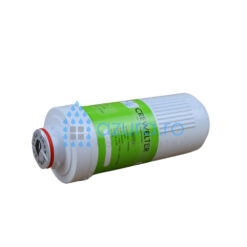 Replacement filter 1ST Crewelter 9/MEDIQUA
1 × 310.00 lei
Replacement filter 1ST Crewelter 9/MEDIQUA
1 × 310.00 lei -
×
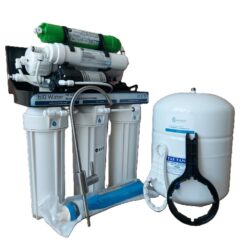 REVERSE OSMOZATION WATER FILTER OSMOZATION BLUE HP75-AG, ALKALINE pH 8,5
2 × 1,530.00 lei
REVERSE OSMOZATION WATER FILTER OSMOZATION BLUE HP75-AG, ALKALINE pH 8,5
2 × 1,530.00 lei
HARD WATER
Hard water, modern man's problem!
21
Jan
Jan
Hard water is modern man's problem
All of us who had the opportunity to see our grandparents living in the country, remember that when it rained, they used to place pots to collect rainwater. They did this in order to wash their clothes with it. They found that well water did not wash as well as rain water, which is absolutely true. Rain water is devoid of hardness, of salts, which well water has plenty of. They didn't have a problem with hard water like modern man does. They used water from the well for drinking, cooking and for watering animals, possibly to water the plants in the garden, and for washing they used rainwater.
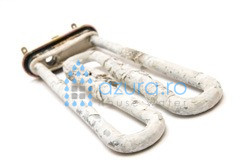
Modern man wanted comfort. This means he wants to turn on a tap and hot or cold water to flow in abundance. The modern man has no time to collect rainwater, nor does he conceive of washing clothes with his hands as our grandparents did. The modern man has installed pressure pumps, central heating, boilers, etc. From this moment on hard water problems. This water contains salts that are deposited on the pipes, in the central heating system, in the boiler, in the washing machine etc., gradually forming a hard crust, which significantly reduces heat transfer, reduces the water flow by narrowing the pipes, increases the maintenance costs of a house with heating and service, leaves white marks and hard to clean on the bathtub, sink, dishes etc.
Another hard water problem is in the industrial area
In many cases, a salt-free, mineral-free water is needed for the equipment to run smoothly. There are cases where many pieces of equipment are out of service or require servicing because of limescale.
In conclusion, we could say that hard water is in fact a major problem regarding the following points:
- central heating, boiler, pipes, batteries
- increases heating costs by reducing heat transfer
- leaves hard-to-clean white stains on dishes, sinks, bath tubs, which is annoying in many cases
- does not foam with detergent/soap which leads to higher detergent/soap consumption
- in many cases, it blocks and disables equipment used in industry
We consider that hard water is not a problem for consumption. There is one exception, only if your doctor has advised you to drink water low in minerals, then hard water can be a problem. In any other case, hard water is safe to drink because water hardness actually consists of calcium and magnesium salts, which are beneficial to the human body.
What is the technical solution if you are confronted with hard water?
There are several variants:
The classic thimbler
- The classic thimbler, that is the ion exchange resin, popularly known as ”salt softener”. Basically, this equipment reduces the hardness of water to less than 1 degree German, i.e. it softens the water. This technique uses a cationic resin that makes an ion exchange. It stops calcium and magnesium ions in the water, ions that are responsible for limescale build-up in the system, and instead introduces sodium, or salt;
- It is a very popular method with measurable effects. The disadvantage of this technology is that you have salt consumption that has to be purchased, carried (25 kg bags) and in general there is a continuous discomfort. Especially if this softener is owned by an elderly person or someone having a hernia or spinal surgery, this is not desirable. In addition, if the house is equipped with a septic tank, a significant amount of salt water will end up in the septic tank. Not only will it need to be drained more often, but its proper functioning will also be affected by the salt water. However, the classic softener is the most popular and widely used technology for hard water problems.
The TAC salt-free thimbler
- A TAC salt-free softener is actually a conditioner. It does not soften the water! The water will have the same amount of calcium and magnesium ions before and after the TAC. More clearly, water will have the same hardness with and without the TAC softener. If, however, through tests or through water analysis you identify the hardness of the changed water, it is not from the TAC saltless water softener but more likely from the time period between the two water tests (the water source does not always have exactly the same hardness), or from water tests that are not accurate to 100%. There is always a certain margin of error in water hardness tests and even in water analysis carried out in an accredited laboratory.How does a TAC salt-free softener work anyway?TAC salt-free softener technology is best defined as (very small) co-polymer beads with a special coating under the influence of which calcium and magnesium minerals precipitate into calcium carbonate microcrystals. TAC beads attract calcium and magnesium ions and release calcium carbonate conglomerates in the form of microcrystals. These microcrystals are invisible to the naked eye and float in the water, through the pipes, until the user uses the water in the bath, sink, shower, washing machine, etc.Is TAC salt-free softening technology tested and accredited?Yes, by the German DVGW standard protocol, article D512, which refers to the testing of water treatment appliances for the reduction of scale deposits. Result of this test: TAC Next Scale Stop reduces scale deposits by 99,6%, similar to a softener based on ion exchange technology (salt softener).In addition, the TAC filter media is NSF certified. This certification is only intended to prove that the water can be consumed without problems, even if it has been treated with this technology. Attention! TAC technology is not to filter/treat non-potable water and make it drinkable!
Scalewatcher electronic scale remover
A Scalewatcher electronic scale remover is a conditioner. It does not soften the water! The water will have the same amount of calcium and magnesium ions before and after treatment with the Scalewatcher. More clearly, the water will have the same hardness with and without the Scalewatcher scale remover.
If, however, through tests or water analysis you identify the changed water hardness, it is not from the effect of the Scalewatcher water softener, but more likely from the time period between the two water tests (the water source does not always have exactly the same hardness), or from water tests that are not accurate to 100%. There is always a certain margin of error of water hardness tests and even water analysis performed in an accredited laboratory.
How does a Scalewatcher electronic scale remover work anyway?
This technology consists of an electronic unit that transmits a signal to a cable that is wound on a water pipe.
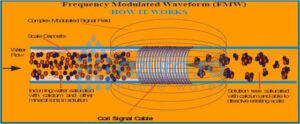
Untreated water before the coil (the electrical wire wrapped around the pipe) forms deposits because the minerals contain negative and positive polarities. Because the pipes are charged with negative polarity, it attracts the positively charged minerals and thus creates deposits.
Electronically treated water - water passing through the coil installed on the pipe forms clusters of crystals that are predominantly negatively charged. Since the pipes are also negatively charged, these formed crystals are repelled by the pipes and float in the water without adhering to surfaces. On the other hand, the limescale deposits are dissolved by the carbon dioxide (CO2) formed as a result of crystallization (crystallization) and are removed from the pipes step by step. These crystals are suspended in water (float) and can be flushed out with the water (reach the sewer through the use of water).
This type of treatment has two advantages:
Immediately prevents deposits in installations;
Step by step clean the deposits from the installations.
Electronic scale removers also solve the following problems in process water:
Dissolves mineral deposits in installations, including silicate deposits;
RUST - removes and replaces rust with a thin layer called MAGNETITE.
Magnetite - is a mineral formed from black iron oxide, Fe3O4, with magnetic properties. It is a metal used in the manufacture of steel, nails, kitchen equipment, tools, bridges, various constructions, used in the automotive industry, railroads, etc.
Soiling - reduces biofilm, so bacteria are reduced;
Algae - algae reduction.
Is Scalewatcher's anti-scale treatment technology tested and accredited?
Yes, by Portsmouth University. The result of the test under real working conditions, Scalewatcher has a excellent performance against hard water. To see the report, click on: University of Portsmouth test report.
The legitimate defending question: how do I correctly choose between the three technologies presented above?
It's a good question and the short answer is: Contact us and based on a few questions, we can suggest the right technology for you. Here you can contact us: Contact
Basically we want to understand what you want and you should consider the following points:
- Do you want water to stop affecting your central heating system, boiler, washing machine, batteries and faucets? Or do you want the white spots on sinks and dishes to disappear completely or be reduced? The calsic water softener is the only one that will help the white spots disappear completely or partially (depending on how hard the water is, there is a possibility that the white spots on the dishes, batteries, sink, shower screen, may not disappear completely);
- Are you not interested in reducing white spots, but do you want your central heating system, boiler, washing machine and the inside of taps and batteries to avoid limescale build-up? In this case you can use both the TAC salt-free water softener and the Scalewatcher scale remover;
- Don't want to flush your septic tank too often or don't want to be dependent on carrying bags of salt? In this case the classic softener is out of the options and only two options remain: the TAC saltless softener and the Scalewatcher Scalewatcher.
As you can see, there is no perfect hard water treatment technology, only technologies that have advantages and disadvantages. If you have further questions, we are open and happy to answer.
Below, other articles dealing with the subject of hard water, by explaining the treatment technologies.
Water softener, the technical solution for removing limescale from water
Did you know that a deposit of just 1.5 mm limestone increases your bill by 15%?
Are you tired of chemical cleaning of the central heating system?
 English
  Romanian
  Spanish
Can the magnetic filter have a negative influence on the drinking water?Calcium and magnesium ions (necessary for the body) remain in the water after passing through the magnetic filter?
Hello,
Our magnetic filter has no negative influence on your health. On the contrary...more information about magnetized water and its health benefits can be found on the blog https://apamagnetizata.wordpress.com/ Calcium and magnesium ions remain in the water after passing through the magnetic filter.
Be careful what type of magnetic filter you use. With most „magnetic filters” the water comes in direct contact with the magnet. With Aqua Soft Natural, the magnets are encapsulated and the water does not come in direct contact with the magnets. In other words, none of the materials from which the magnets are made migrate into the drinking water.
Good day!
azura.ro team